


Emerging Trends in Information and Communication Technologies: 2021
 As we’ve entered a new year, it’s a great time to look at some of the emerging trends in the Information and Communication Technologies (ICT) field. At the pace of current technology, it would be easy for a person or company to fall behind. Our Information and communications technology (ICT) industry is changing and moving forward at an unprecedented pace with many customers implementing new technology or updated advances into their ICT infrastructure and networks.
From purely a business standpoint, this is a good thing for our companies and their employees. Technology often necessitates the installation of better copper cable (i.e., Cat6A) new and improved fiber (i.e., OM5) and replacing existing hardware (i.e., Old Access Points). Advancements in POE, WIFI, Building Automation System (BAS) and others are creating many opportunities and challenges for companies and their employees.
As we’ve entered a new year, it’s a great time to look at some of the emerging trends in the Information and Communication Technologies (ICT) field. At the pace of current technology, it would be easy for a person or company to fall behind. Our Information and communications technology (ICT) industry is changing and moving forward at an unprecedented pace with many customers implementing new technology or updated advances into their ICT infrastructure and networks.
From purely a business standpoint, this is a good thing for our companies and their employees. Technology often necessitates the installation of better copper cable (i.e., Cat6A) new and improved fiber (i.e., OM5) and replacing existing hardware (i.e., Old Access Points). Advancements in POE, WIFI, Building Automation System (BAS) and others are creating many opportunities and challenges for companies and their employees.
Trend #1: Increase of uses for PoE 802.3bt 100W
One of the current trends in information technology is the proliferation of PoE 802.3bt throughout the industry will continue to add things we can power over network cables. As the technology has improved, you can see from the table below that we’ve greatly increased the ability to deliver power to devices through data cables.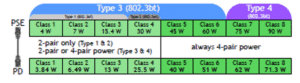
uses for PoE 802.3bt 100W table image Table [1]
Trend #2: Wi-Fi 6 (802.11ax) Standard and its impact on the industry
One of the latest trends in information technology includes WI-FI. As Wi-Fi 6 is being deployed on a larger scale, many companies are upgrading cabling to wireless access points, replacing existing access points and adding more to existing networks. This is helping meet the demand for faster and more prolific Wi-Fi in the commercial and residential markets. The Wi-Fi Alliance®, the worldwide network of companies that brings you Wi-Fi® predicts that: “Wi-Fi 6 will see strong global adoption across PCs, access points, smartphones, and IoT devices in enterprises, homes, and public arenas – with nearly 2 billion Wi-Fi 6 device shipments expected in 2021.”[2]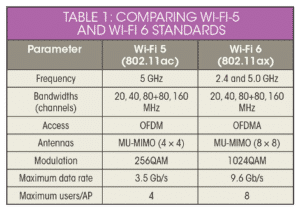
Table 1
Trend #3: Building Automation Systems (BAS)
Building Automation Systems (BAS)** are impacting the construction industry for new buildings and becoming increasingly important for updating/upgrading existing buildings. The American Society of Heating and Air-Conditioning Engineers (ASHAE) has a Standard 135-2020 that uses BACnet, a data communication protocol for building automation and control networks. These systems are connecting multiple trades to one consolidated and manageable tool for facilities and maintenances managers. BAS systems can increase efficiencies of existing buildings by better controlling and managing building resources. These systems reduce heating and lighting costs, increase productivity and increase safety and security. With the ability to turn an ordinary building into a smart building, some of the many things that can be integrated and controlled into these systems include ambient light control (shading), audio, door access, fire alarms, HVAC, lighting, surveillance, and more.Trend #4: Optimizing Cable Pathways
As space in cable trays and baskets decreases due to larger diameter cables and increased cables for other devices on the network, the optimal way to increase space in pathways is to do more bundling for better cable management. Professional installers should consider doing more bundling of cables in cable pathways. Many are still bundling cables ONLY where they exit the pathways. We’re at an inflection point where it makes sense to bundle cables within the cable pathways. Dressing cables inside cable pathways provides cleaner installations and make it easier to identify specific pulls, devices, and applications – as well as leaving additional room for future network expansion. We are seeing a trend towards this additional optimization in 2021. When bundling cables, both Specifiers and Installers know to use flexible, yet strong hook & loop cable ties. They also know a system is only as good as its weakest link and that nylon ‘zip ties’ can wear through the cabling jacket, be over-tightened, or cause cable impedance issues. With an increase in cables, comes an increase in weight. This makes using nylon ‘zip ties’ less than optimal and makes hook & loop cable ties the perfect solution. Contact Speedtech International and learn more about SPEEDWRAP® Brand Fasteners for bundling, banding, organizing, cable identification and for optimizing cable pathways. ** For additional information on BAS, check out these organizations and their websites. Stay Informed The International Society of Automation https://connect.isa.org/communities/community-home?CommunityKey=BE3B4EAB-7D64-48E2-BFC1-354410DF2356 FacilityManagement.com (http://facilitymanagement.com/leading-building-automation-systems-bas/) The American Society of Heating and Air-Conditioning Engineers https://www.ashrae.org/ This Blog was Prepared by Randy Reusser, RCDD in partnership with Speedtech International, Inc.
Randy Reusser, RCDD, MBA